Real ROI Examples of Generative AI in Business Operations
Generative AI pays off when businesses move beyond small pilots and connect it to everyday operations. From faster customer support and software development to lower processing costs, the biggest gains come from measurable, well-managed use cases. Explore the full article for examples, metrics, challenges, and practical ROI strategies.

Listen to the podcast :

 ChatGPT
  Perplexity
 According to a report published by IBM, achieving a strong return on investment (ROI) with artificial intelligence requires purposeful integration rather than isolated pilot programs. While initial experiments are naturally limited in scope, these narrow use cases rarely deliver significant near-term financial returns. Instead, true value emerges when organizations embed AI deeply into their core operational workflows rather than relying on fragmented, one-off initiatives.
In another 2024 survey published by Hostinger, adoption of artificial intelligence surged dramatically, with 78% of organizations integrating AI into a minimum of one department—marking a 55% jump from the prior year. Customer service, marketing and sales, and IT departments emerged as the leading domains for these AI implementations.
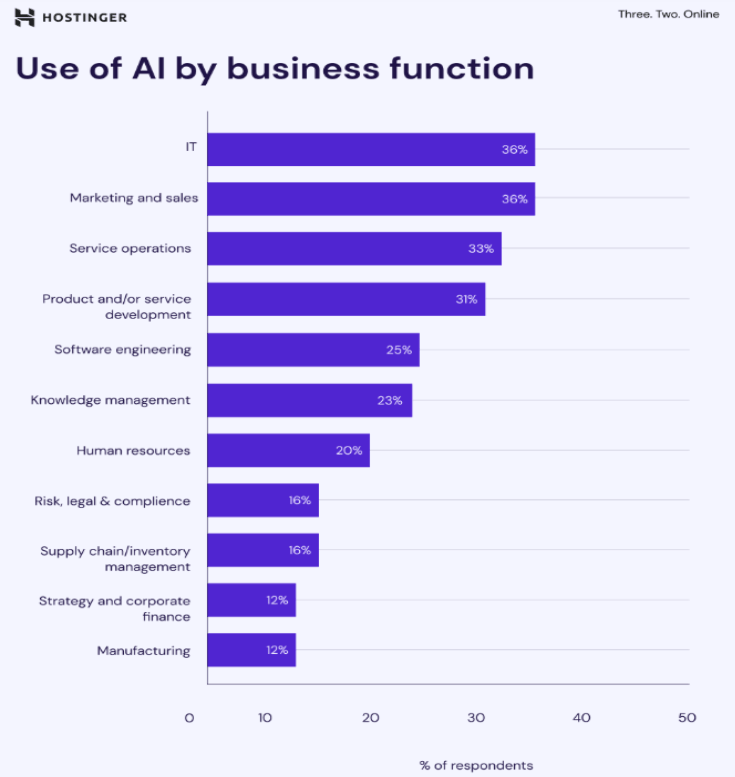
Generative AI delivers clear return on investment in business operations by automating routine tasks, slashing document processing times, and boosting customer support efficiency, allowing enterprises to lower operational costs and significantly accelerate overall workflow productivity.
Ready to Turn Generative AI Into Measurable Business ROI and Sustainable Growth?
Let’s dive deep into the topic. But first, a simple definition:
What is the ROI of Generative AI in Business Operations and Why Does It Matter?
Businesses invest heavily in modern software tools. Corporate leaders demand proof of financial returns. Generative AI ROI represents the financial gain achieved compared to the capital spent on technology deployment. Organizations evaluate generative AI ROI through multiple operational lenses.
- Leaders focus on gen AI ROI because budgets face strict scrutiny.
- Market competition forces firms to adopt enterprise AI ROI models immediately.
- Operational efficiency dictates survival in modern markets while firms track gen AI business benefits closely.
- Cost reduction remains a primary objective and executives examine gen AI cost savings reports every quarter.
- Employees achieve higher gen AI productivity levels with advanced automation tools.
- Companies target gen AI business automation to eliminate manual bottlenecks across departments.
Corporations publish numerous gen AI success stories annually. Stakeholders review real ROI examples of generative AI before approving budgets. Financial analysts study various AI ROI case studies to predict future gains. Organizations expect concrete AI cost savings examples from vendor pitches.
- Corporate boards share enterprise AI success stories during shareholder meetings.
- Teams measure business productivity with AI using internal tracking dashboards.
- Vendors promote specific AI automation ROI examples to attract clients.
- Stakeholders quantify generative AI business benefits through specific accounting formulas.
- Finance departments deploy an AI implementation ROI calculator to estimate net present value.
- Operations managers prioritize AI for operational efficiency across department silos.
Management consultants publish detailed AI business transformation examples regularly. Investors demand proof of return of investment in AI examples before funding projects. Analysts compile distinct AI use cases with measurable ROI for strategic planning sessions. Corporations allocate substantial capital to machine learning models.
Board members require explicit metrics before approving multi-year software contracts. Technology adoption without financial validation creates friction among executive teams. Profit margins shrink when operational software fails to generate measurable cost reductions. Senior management tracks performance indicators weekly to ensure capital efficiency.
Enterprise infrastructure demands continuous monitoring to justify ongoing maintenance budgets. Shareholder value increases only when operational costs decrease significantly. Market leaders set benchmarks for successful digital transformation initiatives.
Financial controllers analyze amortization schedules for advanced machine learning deployments. Every operational department faces pressure to prove financial accountability.
How Businesses Measure the Return on Investment (ROI) of Generative AI Projects
Businesses measure their generative AI implementation with return on investment by establishing performance baselines, tracking financial metrics like labor cost savings, and evaluating qualitative gains such as customer satisfaction and employee productivity.
Here are a few factors to keep in mind:
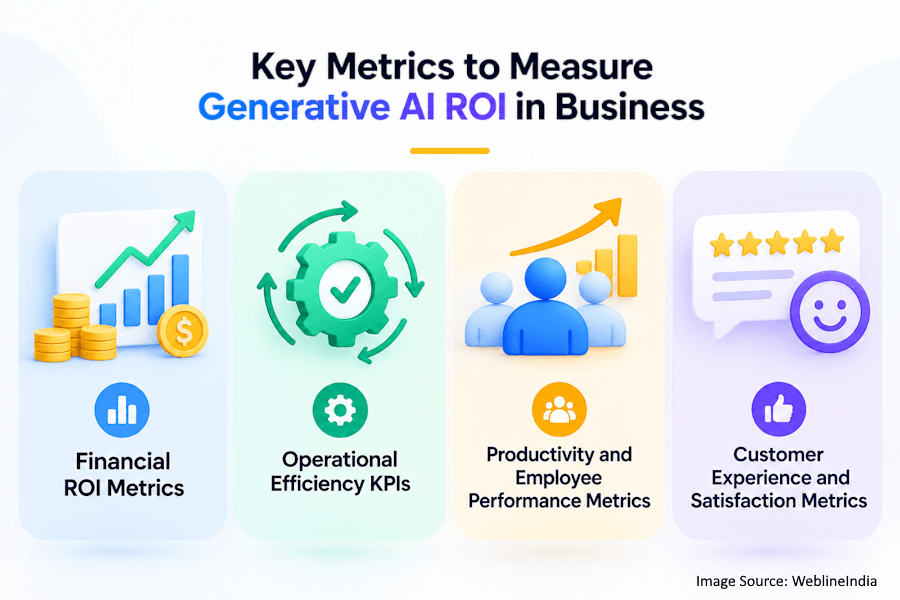
Financial ROI Metrics
Net income calculations reveal actual profits. Capital expenditures decrease significantly after system deployment. Total cost of ownership drops below initial projections. Revenue generation increases through automated upselling workflows. Cash flow statements highlight capital preservation across administrative departments. Balance sheets reflect optimized technology asset valuations over time.
Operational Efficiency KPIs
Cycle times decrease across administrative workflows. Error rates drop below one percent. Resource allocation improves across manufacturing floors. Output volume triples without staff expansion. Equipment utilization rates climb steadily following system integration. Maintenance schedules optimize automatically to prevent unexpected factory shutdowns.
Productivity and Employee Performance Metrics
Tasks finish within minutes instead of hours. Staff members handle higher ticket volumes daily. Employee burnout metrics drop substantially. Training periods shorten for new hires. Daily output targets exceed historical benchmarks consistently. Staff retention rates improve as repetitive manual tasks disappear completely.
Customer Experience and Satisfaction Metrics
Resolution times shrink to seconds. Client retention rates rise steadily. Support tickets resolve on the first contact. Customer feedback scores reach record highs. Net promoter scores improve across all major demographic segments. Customer churn decreases dramatically following automated service personalization.
Real Generative AI ROI Examples Across Business Operations and Enterprise Functions
Enterprise-wide generative AI deployments through enterprise ai development services can streamline software engineering with code assistants, cut marketing content creation time, automate document extraction in back-office operations, and deploy internal knowledge copilots to boost overall workforce productivity.
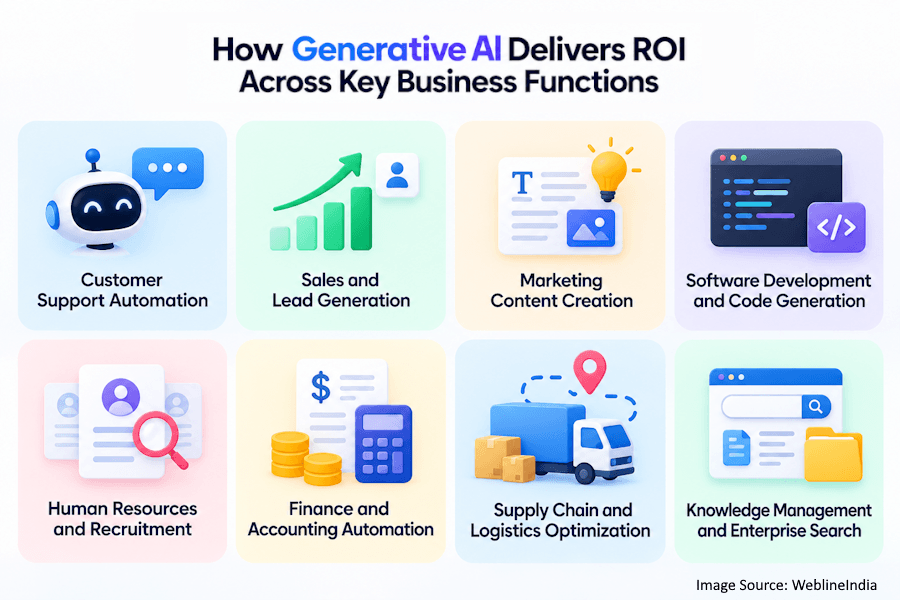
Customer Support Automation
Chatbots handle routine inquiries instantly. Support teams resolve complex tickets faster. Operational overhead drops significantly. Agents manage escalated issues with complete context histories. Customers receive accurate answers without waiting on prolonged phone queues.
Sales and Lead Generation
Outreach emails personalize automatically. Conversion rates increase across regional pipelines. Sales teams close deals faster. Lead scoring models prioritize high-value prospects efficiently. Account executives spend more time conducting direct client consultations.
Marketing Content Creation
Copywriters generate drafts in seconds. Campaign localization expands into new markets. Marketing costs drop drastically. Creative directors optimize brand consistency across multiple digital channels. Advertising campaigns launch weeks ahead of traditional schedules.
Software Development and Code Generation
Developers write software code rapidly. Bug detection occurs before production deployment. Engineering velocity triples. Testing teams validate releases using automated scripts. Technical debt decreases across legacy application codebases.
Human Resources and Recruitment
Resume screening completes in seconds. Candidate matching improves through semantic search. Hiring managers save countless hours. Onboarding paperwork processes automatically. Employee engagement surveys analyze sentiment trends instantly.
Finance and Accounting Automation
Invoice processing runs without manual entry. Financial reporting speeds up. Audit compliance improves dramatically. Expense report verification occurs in real-time. Cash flow forecasting accuracy increases across fiscal quarters.
Supply Chain and Logistics Optimization
Inventory forecasting prevents stockouts. Delivery routes adjust dynamically. Shipping costs decrease globally. Warehouse pick lists optimize through smart spatial algorithms. Supplier lead times track accurately against historical benchmarks.
Knowledge Management and Enterprise Search
Internal documentation surfaces instantly. Onboarding accelerates for new employees. Information silos disappear entirely. Training manuals update dynamically based on policy changes. Expert locators connect staff members with relevant project specialists.
Industry-Wise Generative AI ROI Examples That Deliver Measurable Business Value
Generative AI creates distinct economic value across sectors, with financial services driving compliance automation, retail boosting sales through hyper-personalization, manufacturing optimizing supply chains, and healthcare accelerating diagnostic workflows to yield significant industry-specific returns on investment.
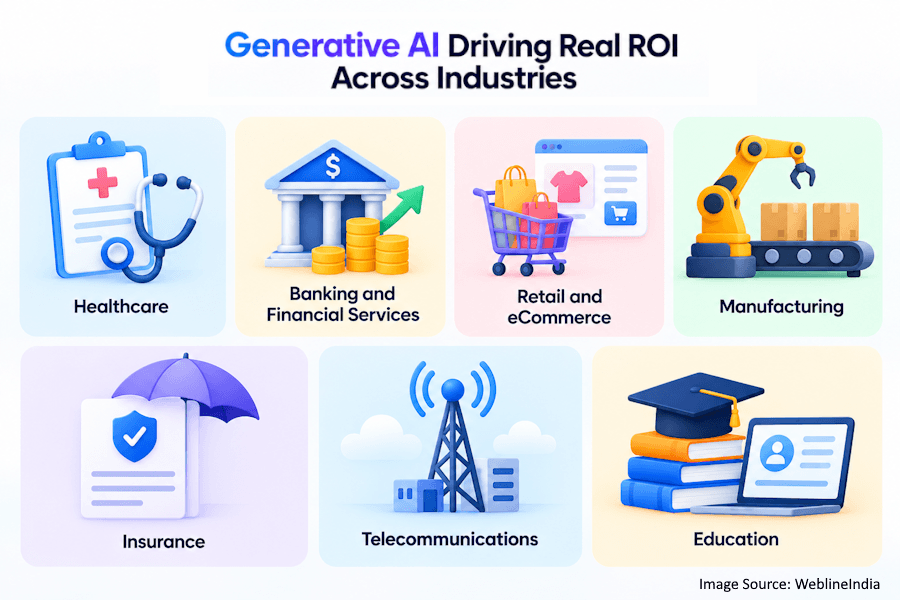
Healthcare
Diagnostic imaging analysis speeds up. Patient record summarization reduces administrative burden. Treatment planning improves significantly. Clinical documentation workflows finish prior to shift changes. Patient readmission rates decline through predictive discharge planning.
Banking and Financial Services
Fraud detection systems flag anomalies instantly. Loan underwriting completes within minutes. Risk assessment models update continuously. Regulatory compliance reporting finalizes without manual document collation. Customer portfolio rebalancing executes according to risk profiles.
Retail and eCommerce
Product descriptions generate at scale. Recommendation engines drive higher cart values. Inventory management stabilizes. Dynamic pricing algorithms respond to market demand signals. Visual search tools help shoppers find matching apparel items instantly.
Manufacturing
Predictive maintenance prevents machine downtime. Quality control cameras spot defects instantly. Production schedules optimize automatically. AI-powered logistics automation can help address supply chain bottlenecks before they impact assembly lines. Worker safety monitoring identifies potential workplace hazards proactively.
Insurance
AI-powered insurance automation can streamline claim processing and policy administration. Risk evaluation accuracy rises. Fraud rings face rapid detection. Policy renewal notices generate personalized risk assessments. Adjuster workloads distribute evenly across regional office locations.
Telecommunications
Network maintenance tickets resolve faster. Customer churn prediction models trigger retention campaigns. Service provisioning automates completely. Field technician dispatch schedules optimize using traffic data. Network capacity planning utilizes predictive demand modeling.
Education
Personalized tutoring scales globally. Automated grading saves instructor hours. Course material generation accelerates. Student engagement tracking identifies learners needing extra support. Administrative enrollment workflows process without manual delays.
Want to Identify the Highest-ROI Generative AI Use Cases for Your Business Operations?
Key Business Benefits of Generative AI That Improve ROI and Operational Performance
Generative AI elevates operational performance and maximizes ROI by automating complex workflows, minimizing human error, accelerating product development cycles, and scaling personalized customer interactions, which collectively drive substantial long-term enterprise value and efficiency gains.
Here are the benefits:
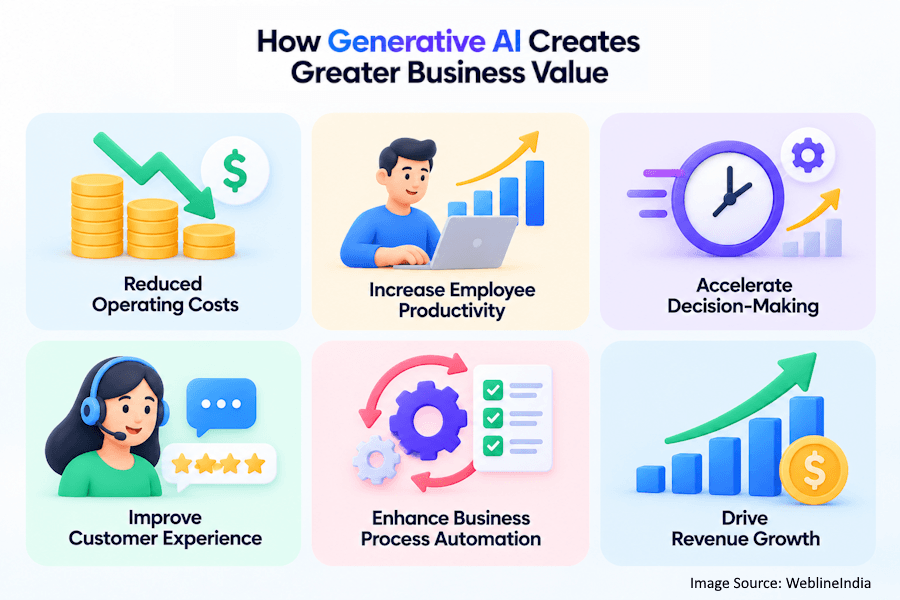
Reduced Operating Costs
Overhead expenses shrink rapidly. Manual labor requirements decrease. Software license consolidation saves capital. Facility utility costs optimize through smart building integration. Printing and paper expenses disappear entirely from administrative offices.
Increase Employee Productivity
Staff output doubles within weeks. Routine tasks vanish from daily schedules. Focus shifts toward strategic initiatives. Collaboration tools streamline inter-departmental communication channels. Project milestone delivery timelines shorten across all operational business units.
Accelerate Decision-Making
Data insights synthesize instantly. Management reviews reports without delay. Strategic pivots happen faster. Executive dashboards display real-time financial performance metrics. Competitive market intelligence updates continuously without manual research efforts.
Improve Customer Experience
Clients receive instant answers. Support availability extends to 24/7. Personalization deepens customer loyalty. Client onboarding journeys complete with minimal friction. Feedback loops route customer sentiments directly to product development teams.
Enhance Business Process Automation
Organizations can use business process automation services to reduce manual intervention in workflows, streamline system integrations, and address operational bottlenecks. Error correction loops trigger autonomously upon anomaly detection. Cross-departmental data handoffs occur without manual verification delays.
Drive Revenue Growth
Sales pipelines expand rapidly. New product launches happen sooner. Market penetration accelerates globally. Cross-selling accuracy improves through predictive customer analytics. Pricing strategies adapt instantaneously to shifting competitive pressures.
Common Challenges That Impact Generative AI ROI and How Businesses Can Overcome Them
Common challenges like data privacy risks, model hallucinations, and high integration costs often hinder generative AI ROI. Businesses overcome these hurdles by enforcing strict security guardrails, implementing rigorous data validation, and prioritizing high-impact, scalable pilot projects.
Here are some:
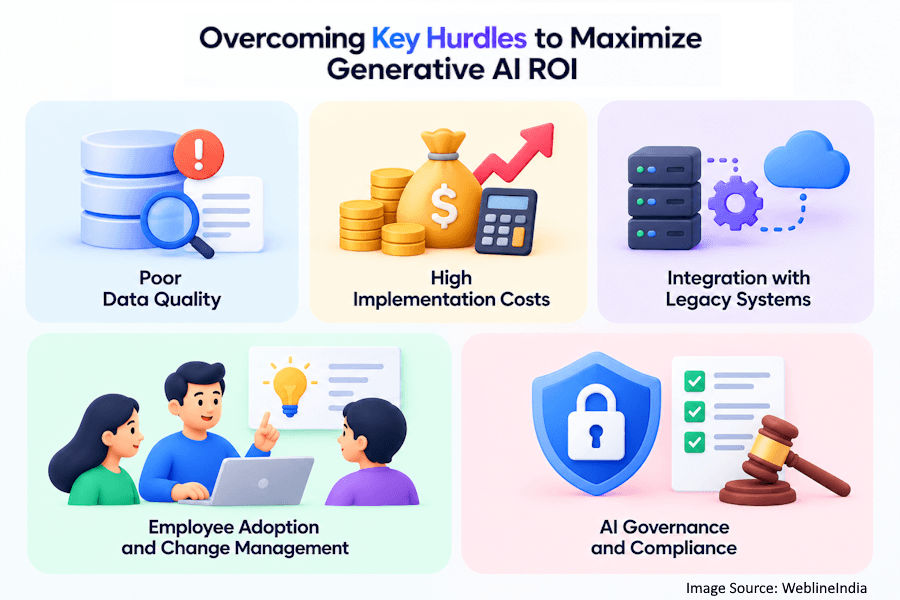
Poor Data Quality
Garbage inputs produce inaccurate outputs. Data cleansing requires dedicated resources. Governance frameworks ensure data integrity. Automated validation pipelines filter corrupted records continuously. Master data management strategies unify disparate corporate information repositories.
High Implementation Costs
Initial infrastructure demands large budgets. Cloud computing expenses scale quickly. Phased deployments control spending. Vendor negotiation secures favorable enterprise licensing agreements. Capital expenditure models transition smoothly toward predictable operational expenditure structures.
Integration with Legacy Systems
Old databases resist modern APIs. Custom middleware bridges communication gaps. Gradual modernization prevents operational failure. Microservices architecture isolates older legacy components effectively. Data pipelines translate legacy formats into modern vector embeddings.
Employee Adoption and Change Management
Staff members resist unfamiliar tools. Comprehensive training programs build confidence. Internal champions drive cultural shifts. Continuous feedback channels address user concerns promptly. Incentive structures reward teams for successful tool integration.
AI Governance and Compliance
Data privacy regulations pose legal risks. Compliance monitoring tools prevent breaches. Ethical guidelines direct model outputs. Legal teams review training datasets for intellectual property violations. Access control policies restrict sensitive corporate data exposure.
Best Practices for Maximizing Generative AI ROI in Business Operations
Maximizing generative AI return on investment requires aligning high-impact use cases with core business objectives, investing in clean data pipelines, and continuously tracking performance metrics to ensure sustainable operational efficiency gains.
Follow these practices to maximize generative AI ROI.
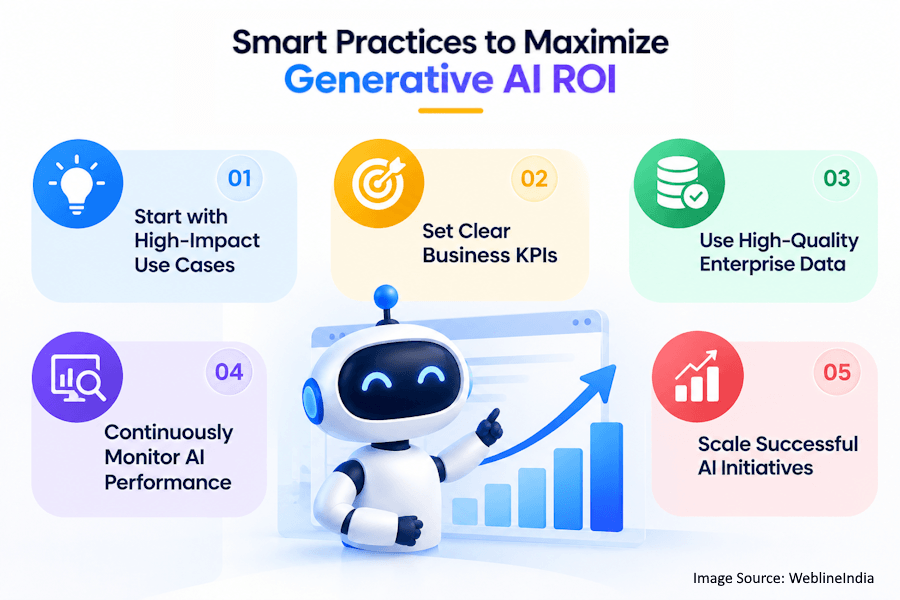
Start with High-Impact Use Cases
Low-hanging fruit proves immediate value. Quick wins secure executive buy-in. Pilot projects test system stability. Departmental leaders can use ai consulting services to identify manual tasks consuming excessive labor hours and prioritize appropriate opportunities for initial deployments.
Set Clear Business KPIs
Metrics track financial gains accurately. Performance targets remain transparent. Adjustments happen based on data. Baseline measurements establish pre-implementation performance standards. Executive reporting dashboards display ROI milestones monthly.
Use High-Quality Enterprise Data
Clean data yields reliable results. Custom prompts align with business logic. Internal repositories feed secure models. Vector databases index corporate documentation securely. Retrieval-augmented generation frameworks ground model responses in verified facts.
Continuously Monitor AI Performance
Drift detection tools flag output errors. Regular audits ensure model accuracy. Quality checks maintain operational standards. Automated evaluation pipelines test model responses against benchmark datasets. Human-in-the-loop validation reviews edge case failures.
Scale Successful AI Initiatives
Proven models deploy across departments. Infrastructure expands to handle volume. Investments grow with verified returns. Enterprise resource planning systems integrate validated machine learning modules. Change management frameworks support wider organizational adoption phases.
How to Calculate Generative AI ROI for Your Business: A Practical Framework
Calculating generative AI ROI involves identifying initial implementation costs, quantifying direct benefits like labor savings and productivity gains, and measuring these against ongoing maintenance expenses using a structured formula to evaluate true financial impact.
Here are the steps to calculate generative AI ROI for your business:
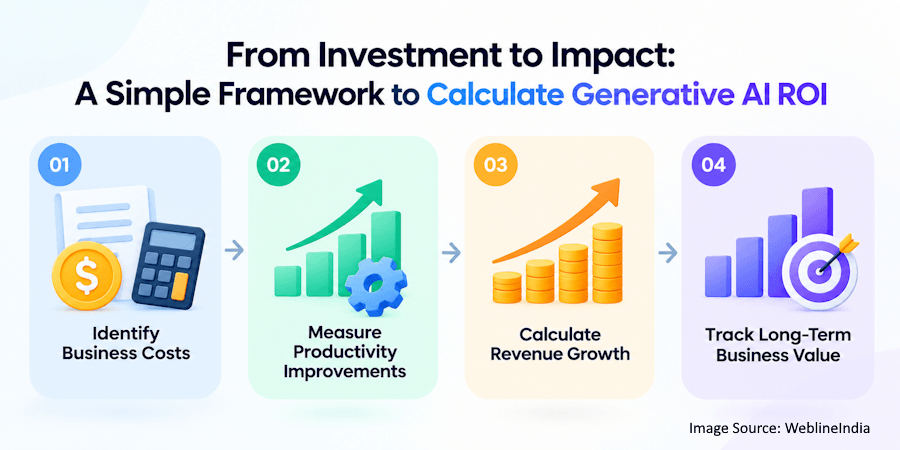
Identify Business Costs
Software licensing fees add up quickly. Infrastructure maintenance requires steady budgets. Training expenses impact initial capital. Consultation fees add to total implementation costs. Internal staff hours spent on deployment factor into total expenses.
Measure Productivity Improvements
Time saved translates directly to money. Output metrics confirm efficiency gains. Labor cost reductions offset investments. Hourly wage equivalents are multiplied by hours saved weekly. Departmental output volume increases validate labor efficiency claims.
Calculate Revenue Growth
Increased sales volume boosts profits. New market entries generate income. Conversion rate bumps drive revenue. Average order value increases contribute directly to top-line figures. Customer lifetime value expansions improve long-term financial forecasts.
Track Long-Term Business Value
Compounding gains appear over years. Strategic advantages outlast initial expenses. Asset valuation increases with capability. Intellectual property development strengthens competitive market moats. Employee skill enhancement reduces long-term hiring and recruitment overhead.
Future Trends Driving Higher Generative AI ROI Across Enterprise Business Operations
Future trends like autonomous agentic workflows, domain-specific fine-tuning, and decision intelligence integration are expanding generative AI from simple task automation into core enterprise infrastructure, driving faster problem-solving, greater scalability, and compounding long-term operational ROI.
The trends:
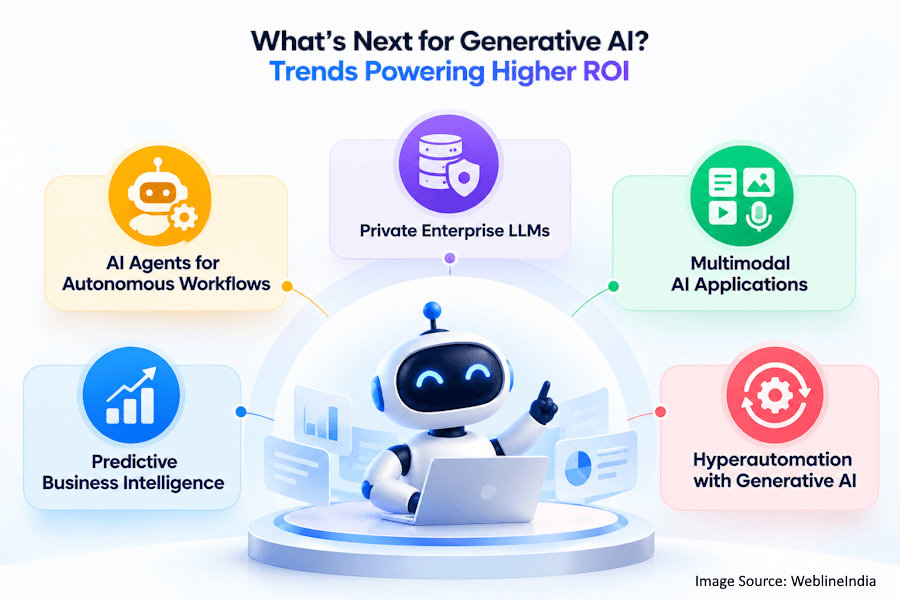
AI Agents for Autonomous Workflows
With agentic ai development services, organizations can build agents that execute multi-step tasks independently while human oversight shifts toward monitoring and managing complex operational sequences. As AI agent development for enterprises matures, these systems can support real-world automation, decision-making, integration, and scalable business workflows.
Private Enterprise LLMs
Corporate data stays secure inside firewalls. Models adapt specifically to company needs. Accuracy improves across internal queries. Proprietary algorithms protect trade secrets from external exposure, while ai model fine tuning services can help incorporate specific corporate domain terminology.
Multimodal AI Applications
Systems process text and images together. Audio data integrates into analytics pipelines. Complex operations streamline entirely. Field inspection photos are analyzed automatically for structural defects. Voice logs synthesize into structured customer service database records.
Predictive Business Intelligence
Forecasting models anticipate market shifts. Inventory levels adjust before demand spikes. Financial risks are mitigated early. Economic indicators are processed alongside internal sales metrics. Strategic planning sessions rely on high-fidelity simulation models.
Hyperautomation with Generative AI
Robotic process automation merges with neural networks. End-to-end workflows run without pauses. Operational bottlenecks vanish completely. Enterprise systems coordinate actions across disparate software platforms. Human workers intervene only during high-level strategic exceptions.
How to Choose the Right Generative AI Development Partner to Maximize Business ROI
Choosing the ideal generative AI development partner requires evaluating their technical expertise, industry domain experience, and security standards to ensure seamless enterprise integration, risk mitigation, and the realization of maximum long-term operational ROI.
Check these factors to choose the best generative AI development partner for your business:
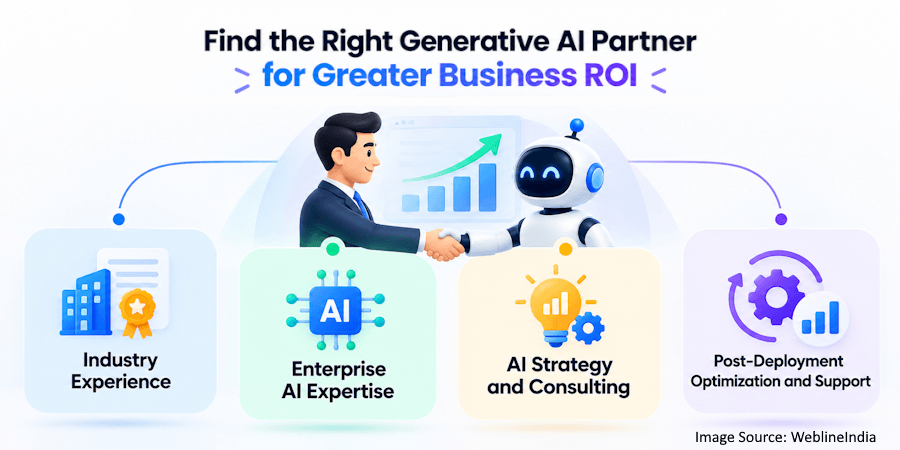
Industry Experience
Specialized vendors understand sector nuances. Past projects prove capability. Domain knowledge accelerates deployment. Regulatory compliance requirements receive proper technical attention. Industry-specific data structures integrate smoothly with custom models.
Enterprise AI Expertise
Engineers build scalable architecture. Security protocols protect corporate assets. Custom solutions fit unique workflows. Distributed computing clusters handle intensive model training workloads. High-availability configurations prevent unexpected system downtime incidents.
AI Strategy and Consulting
Experienced providers of enterprise generative ai consulting services can map out realistic roadmaps, conduct risk assessments and feasibility studies, and recommend technology stacks that prioritize long-term scalability and cost efficiency.
Post-Deployment Optimization and Support
Maintenance keeps systems running smoothly. Updates improve model performance. Technical support resolves issues instantly. Performance tuning reduces cloud computing resource consumption. Continuous monitoring protects deployed models against emerging security vulnerabilities.
Final Thoughts on Achieving Measurable Business Value with Generative AI
Generating tangible financial returns requires disciplined strategy and precise execution. Companies must prioritize use cases that solve critical operational bottlenecks. Technology investments yield maximum value when aligned with core business objectives. Continuous monitoring ensures systems maintain high performance over time. Selecting experienced technology partners accelerates deployment timelines and minimizes risks.
- Organizations optimize generative AI implementation roadmaps and rigorous performance tracking.
- Corporate leadership leverages gen AI ROI milestones to secure ongoing operational budgets.
- Enterprise buyers evaluate enterprise AI ROI models before deploying machine learning infrastructure.
- Management teams capture vital gen AI business benefits by focusing on automated workflow efficiency.
- Finance departments measure gen AI cost savings to justify multi-year software expenditures.
- Operational units scale gen AI productivity metrics across customer support and sales pipelines.
- Businesses deploy gen AI business automation frameworks to eliminate repetitive administrative burdens.
Modern enterprises partner with WeblineIndia to build scalable architectures that maximize technology investments. Strategic execution transforms complex workflows into automated profit centers. Organizations achieve sustainable market advantage through expert technical guidance and robust implementation frameworks.
WeblineIndia provides comprehensive development support for businesses seeking guaranteed technical excellence. Corporate leaders trust WeblineIndia to build secure custom applications that optimize daily operations. Technological transformation succeeds through careful planning and flawless engineering execution.
Social Hashtags
#GenerativeAI #GenAI #ArtificialIntelligence #AIForBusiness #AIROI #BusinessAI #EnterpriseAI #AIAutomation #BusinessAutomation #DigitalTransformation #AIProductivity #IntelligentAutomation #EnterpriseAutomation #AIInnovation #BusinessTransformation #BusinessGrowth #WorkflowAutomation #AIBusinessStrategy
Looking to Scale Generative AI Without Increasing Operational Complexity or Implementation Costs?
Frequently Asked Questions
What ROI can businesses expect from generative AI?
Organizations typically achieve returns ranging from three to five times their initial investment within the first year of deployment. Financial gains stem directly from reduced manual overhead and accelerated task completion rates.
How does generative AI improve business productivity?
Advanced text and data models automate routine administrative tasks effortlessly. Employees shift their daily focus toward strategic initiatives and high-value customer interactions.
What are real examples of AI delivering business value?
Customer support teams deploy conversational agents to resolve routine inquiries instantly. Software engineering groups utilize code generation tools to triple development velocity.
Which industries see the highest ROI from AI?
Financial services, retail, and healthcare record the fastest financial returns. These sectors process massive volumes of unstructured data daily.
How do companies measure AI ROI?
Financial controllers evaluate net income changes and capital expenditure reductions. Operational teams track cycle time improvements and error rate decreases.
Can generative AI reduce operational costs?
Automated workflows eliminate the need for extensive manual data entry. Software license consolidation and reduced labor requirements lower overall operating overhead.
What business functions benefit most from AI?
Customer support, marketing content creation, and software development register massive efficiency gains. Human resources also streamline candidate screening workflows significantly.
How much money can AI save a business?
Corporations report thousands of hours saved annually across administrative departments. Labor cost reductions offset initial technology investments within twelve months.
What KPIs should businesses track after AI implementation?
Managers monitor task completion times and error frequencies closely. Customer retention rates and net promoter scores provide reliable long-term performance indicators.
Does generative AI increase employee productivity?
Staff output doubles across routine workflows within weeks of system adoption. Employee burnout metrics drop substantially as repetitive manual chores disappear.
How quickly can AI projects generate ROI?
Small pilot projects demonstrate positive financial returns within three to six months. Enterprise-wide scaling yields compounding financial advantages over multi-year horizons.
What are successful enterprise AI case studies?
Global retail brands automate product description generation to slash marketing expenses. Financial institutions deploy automated fraud detection systems to eliminate compliance fines.
Globally Recognized for Unmatched Quality and Reliability


Testimonials: Hear It Straight From Our Global Clients
Our development processes delivers dynamic solutions to tackle business challenges, optimize costs, and drive digital transformation. Expert-backed solutions enhance client retention and online presence, with proven success stories highlighting real-world problem-solving through innovative applications. Our esteemed Worldwide clients just experienced it.
Awards and Recognitions
While delighted clients are our greatest motivation, industry recognition holds significant value. WeblineIndia has consistently led in technology, with awards and accolades reaffirming our excellence.

OA500 Global Outsourcing Firms 2025, by Outsource Accelerator

Top Software Development Company, by GoodFirms

BEST FINTECH PRODUCT SOLUTION COMPANY - 2022, by GESIA

Awarded as - TOP APP DEVELOPMENT COMPANY IN INDIA of the YEAR 2020, by SoftwareSuggest