From MVP to Scale: Hiring an Indian dedicated development team to build SaaS solutions
Learn how hiring a dedicated development team in India can help SaaS founders move from MVP validation to product-market fit and scalable growth with the right technical expertise, infrastructure, and development strategy.


 ChatGPT
  Perplexity
 The path from a whiteboard sketch to a global platform is a high-stakes journey. In today’s market, a Minimum Viable Product (MVP) is no longer just a “bare-bones” version of an app; MVP development is a strategic tool designed to test core hypotheses while providing enough value to retain early adopters. However, building the product is only half the battle.
Statistics show that most SaaS products fail between the MVP and scaling stages because they cannot handle the transition from a simple prototype to a robust, enterprise-grade solution. This “valley of death” is often caused by technical debt, poor infrastructure, or a lack of specialized talent to manage growth.
To bridge this gap, founders need more than just coders; they need a partner that understands the nuances of the software lifecycle. This is where the decision to hire a dedicated development team from India experts becomes a game-changer.
There is no denying that by choosing SaaS development in India, founders gain access to a mature ecosystem that prioritizes long-term scalability over quick fixes. India has evolved into a strategic destination where dedicated teams act as an extension of your vision, ensuring that the architecture you build today can support the millions of users you plan to acquire tomorrow.
Need the right development team to turn your SaaS MVP idea into a scalable product?
Understanding the SaaS Lifecycle: MVP to Product-Market Fit to Scale
The SaaS lifecycle moves from building a Minimum Viable Product to achieving product-market fit, then scaling operations. Success requires validating demand, refining features, and developing robust infrastructure to transition from prototype to sustainable, enterprise-ready growth.
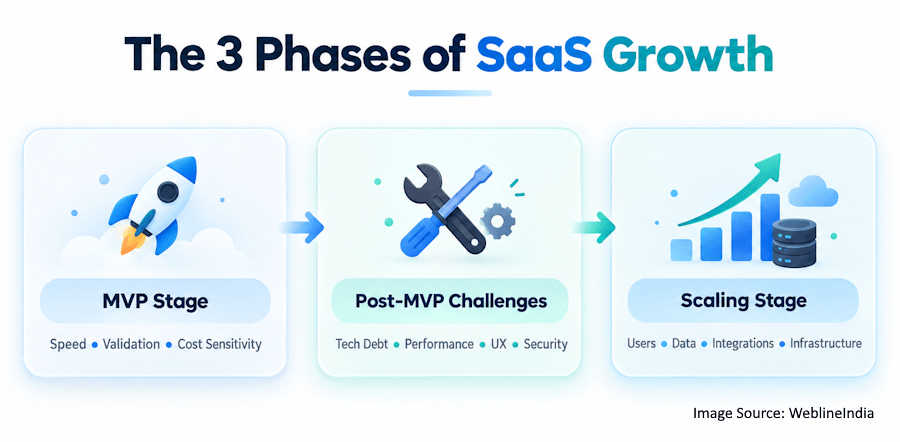
MVP Stage: Speed, Validation, and Cost Sensitivity
The MVP stage is all about velocity and learning, with mvp development services focused on validating the core product idea before investing in broader functionality. At this point, the goal of SaaS development in India is to build a functional prototype that solves a core problem for a specific audience. Founders must balance the need for a polished user experience with the reality of a limited budget. It is a period of high-cost sensitivity where every dollar spent must contribute to validating the product hypothesis.
Engineers focus on building essential features using agile methodologies to get the product into the hands of users as quickly as possible. The priority here isn’t a perfect system, but a stable enough platform to gather real-world data and feedback, ensuring you don’t spend months building something nobody actually wants.
Post-MVP Challenges: Tech Debt, Performance, UX, and Security
Once the initial version is live, the “honeymoon phase” ends and technical debt often starts to accumulate. This stage is critical because the shortcuts taken to launch quickly can become bottlenecks. You might notice slower page loads, minor bugs in the UI, or security vulnerabilities that weren’t a priority during the initial build. Improving the user experience becomes vital to reducing churn.
As you hire dedicated development team India professionals, their focus shifts to refactoring messy code, optimizing database queries, hardening the security layer, and providing ongoing software maintenance services as the product matures. This transition ensures that the foundation of your software is solid enough to support more complex features and a growing volume of user requests without crashing.
Scaling Stage: Users, Data, Integrations, and Infrastructure
Scaling is the ultimate test of your SaaS architecture. This stage involves handling a massive influx of users and managing petabytes of data without compromising performance. It requires moving toward cloud-native solutions, implementing microservices, and ensuring high availability through load balancing.
Beyond internal performance, the scaling stage often demands deep third-party integrations via APIs to make your product part of a wider ecosystem. You are no longer just maintaining an app; you are managing a complex infrastructure. The engineering focus shifts toward devops services, automated CI/CD pipelines, and proactive monitoring to ensure the system stays resilient as the business expands into new markets.
Why Development Needs Evolve at Each Stage
Development is not a “one and done” task; it is a living process that must adapt to the business’s maturity. In the beginning, you need generalist developers who can wear many hats and move fast. As you hit product-market fit, you need specialists in UX and QA to refine the product. Finally, at the scaling stage, you require architects and DevOps engineers to manage the heavy lifting of backend infrastructure.
When you choose to hire dedicated development team India, you gain the flexibility to swap or add these specific skills as your roadmap changes. This evolution ensures that your technical capabilities always align with your commercial goals, preventing the tech stack from becoming a barrier to growth.
Why Founders Choose Dedicated Development Teams Over Freelancers or In-house
Choosing the right talent model is a make-or-break decision for any startup. While there are many ways to build software, the “dedicated team” model has emerged as the gold standard for those looking to hire dedicated development team India.
- Dedicated Team vs. Freelancers: Freelancers are often great for short-term fixes, but they lack long-term ownership. They might juggle multiple clients, leading to communication gaps. A dedicated team, however, provides continuity. They own the codebase, understand the history of every feature, and remain accountable for the product’s health.
- Dedicated Team vs. Local Hiring: Hiring locally in tech hubs like San Francisco or London is incredibly expensive and time-consuming. It can take months to find a single senior engineer. SaaS development in India allows founders to bypass the local talent war, offering a much faster time-to-market and the ability to scale the team up or down in weeks rather than months.
- Long-term Alignment: Unlike a project-based vendor, a dedicated team lives and breathes your product roadmap. They don’t just “finish a task”; they suggest improvements that align with your future goals.
- Extension of Your Vision: A dedicated team functions as a remote office. They adopt your culture, use your tools, and work toward your vision as if they were sitting in the same room.
Comparison: The Battle of Hiring Models
| Feature | Freelancers | In-House Team | Dedicated Team (India) |
| Commitment | Low (Task-based) | High | High (Product-owned) |
| Cost | Low to Moderate | Extremely High | Optimized/Cost-effective |
| Scalability | Difficult | Slow | Very Fast |
| Accountability | Individual/Limited | High | Team-wide/High |
| Reliability | Variable | High | Consistent & Managed |
Why India Is a Global Hub for SaaS Development
India has transitioned from an outsourcing back-office to a global hub for saas development services. Here is why it remains the top choice:
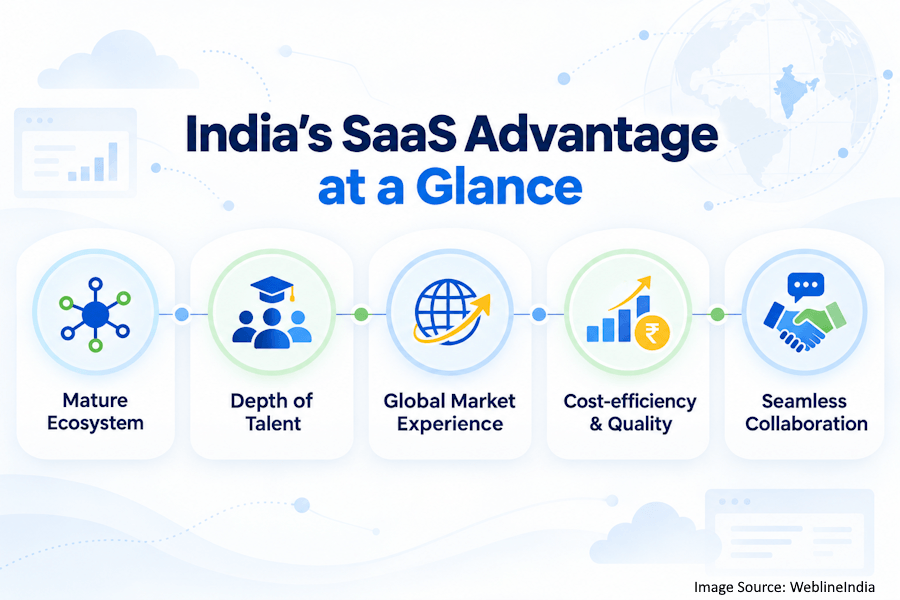
- Mature Ecosystem: India is home to hundreds of successful SaaS unicorns. This means the local workforce understands the specific nuances of subscription billing, multi-tenancy architecture, and churn metrics.
- Depth of Talent: When you hire dedicated development team India specialists, you aren’t just getting coders. You get access to a full stack of professionals, including cloud architects, DevOps specialists, QA engineers, and UI/UX designers who specialize in high-conversion interfaces.
- Global Market Experience: Indian teams have spent decades building products for the US, UK, and European markets. They understand global design standards, data privacy laws, and user expectations across different continents.
- Cost-efficiency & Quality: The lower cost of living in India allows founders to access top-tier talent at a fraction of the cost of Western counterparts. This doesn’t mean “cheap” quality; it means better value for every dollar invested in the product.
- Seamless Collaboration: With high English proficiency and a culture of proactive communication, Indian teams integrate smoothly into Western business workflows, ensuring that project requirements are never lost in translation.
Building the MVP with an Indian Dedicated Team
Building a Minimum Viable Product requires a delicate balance between speed and future-proofing. When you hire dedicated development team India specialists, you are engaging experts who know how to turn a concept into a working product without over-engineering.
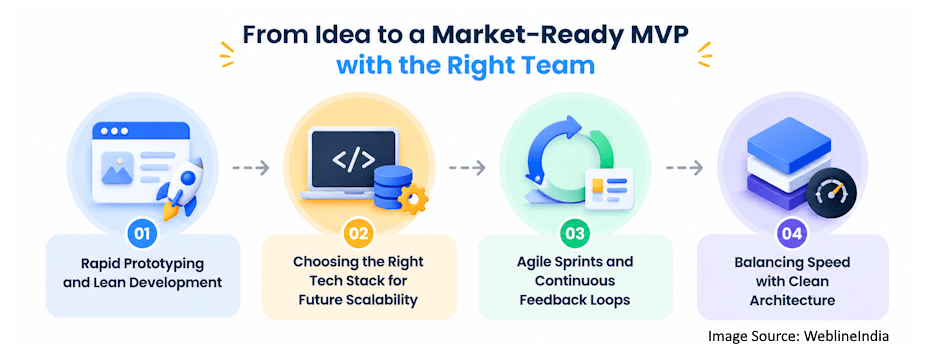
- Rapid Prototyping and Lean Development: The focus is on the core value proposition. Indian teams use lean methodologies to build functional prototypes quickly. By stripping away non-essential features, they ensure your budget is spent on the “must-haves” that prove your business model. This approach allows you to enter the market fast and start collecting user data.
- Choosing the Right Tech Stack for Future Scalability: A common mistake is picking a stack that is easy to build but hard to scale. Professionals in SaaS development in India guide you through selecting robust frameworks such as React, Node.js, or Python, and database structures that can grow with you. This prevents the need for a total rewrite just a year down the line.
- Agile Sprints and Continuous Feedback Loops: The development process is broken into two-week sprints. You see progress in real-time and provide feedback at the end of every cycle. This transparent loop ensures the product evolves exactly as you envisioned and allows for quick pivots based on stakeholder input.
- Balancing Speed with Clean Architecture: While speed is king during the MVP phase, code quality cannot be sacrificed. Dedicated teams emphasize clean code and modular architecture from day one. This means your “quick launch” doesn’t turn into a “technical debt nightmare” when it’s time to add new modules.
As a matter of fact, many founders fail by building too much or ignoring backend security. A dedicated team acts as a consultant, steering you away from feature creep and ensuring that even the first version of your SaaS follows industry-standard security protocols.
Transitioning from MVP to Product-Market Fit
Reaching Product-Market Fit (PMF) is about listening to your users and refining the product until it becomes indispensable. This is where SaaS development in India shifts from “building” to “optimizing.”
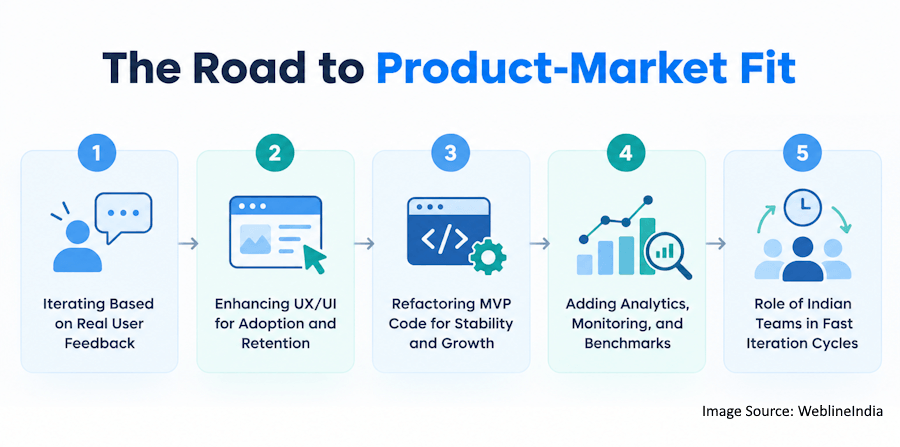
- Iterating Based on Real User Feedback: Once your MVP is live, the data starts flowing in. Dedicated teams help you analyze user behavior and prioritize the features that users actually want. This iterative process ensures that the product evolves in a direction that guarantees market demand.
- Enhancing UX/UI for Adoption and Retention: First impressions matter, but second impressions drive retention. Indian design teams focus on smoothing out friction points in the user journey. It is clear that improving the interface and making the workflows more intuitive helps increase your daily active users and reduce churn.
- Refactoring MVP Code for Stability and Growth: As the user base grows, the “quick and dirty” code from the MVP stage needs to be cleaned up. The team performs refactoring that improves the internal structure of the code without changing its external behavior. This ensures that the platform remains stable under increasing loads.
- Adding Analytics, Monitoring, and Benchmarks: You cannot manage what you cannot measure. During this phase, the team integrates advanced analytics and performance monitoring tools. These benchmarks provide the insights needed to make data-driven decisions about feature updates and infrastructure needs.
- Role of Indian Teams in Fast Iteration Cycles: The ability to iterate quickly is a competitive advantage. Because you hire dedicated development team India resources, you have a team that works in an agile rhythm, allowing you to deploy updates and bug fixes continuously, keeping your early adopters happy and engaged.
Scaling the SaaS Product: How Dedicated Teams Add Value
Scaling is where a product moves from a few hundred users to hundreds of thousands. This transition requires a massive shift in technical strategy, and SaaS development in India provides the specialized expertise needed for this heavy lifting.
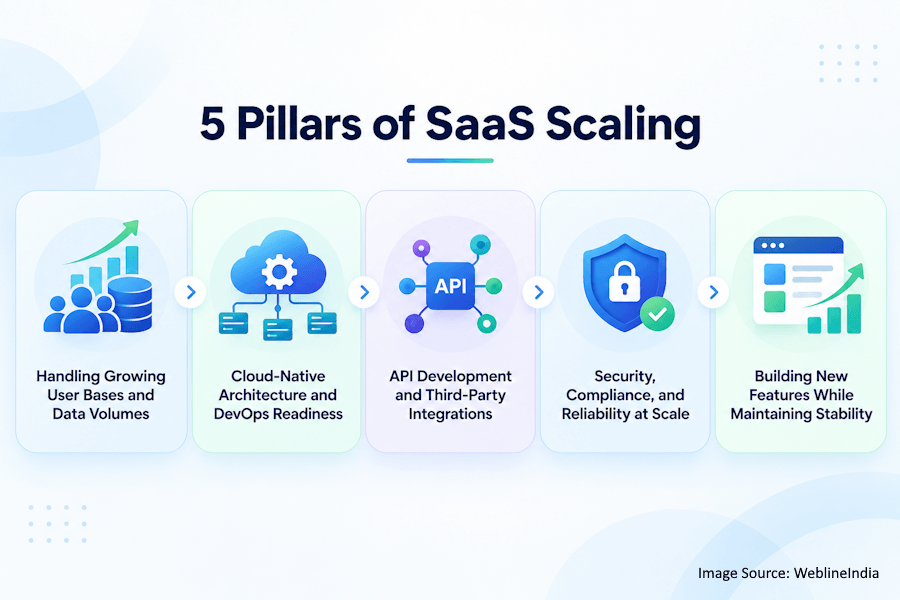
- Handling Growing User Bases and Data Volumes: As your traffic spikes, the backend must keep up—a challenge that becomes especially important when building scalable fintech SaaS solution with real-time transactions and secure integrations. Dedicated teams implement horizontal scaling and database sharding to ensure that an increase in users doesn’t lead to a decrease in speed. They optimize queries and use caching layers like Redis to manage high data throughput efficiently.
- Cloud-Native Architecture and DevOps Readiness: When you hire dedicated development team India, they transition your product to a cloud-native environment (AWS, Azure, or GCP). By utilizing Docker and Kubernetes, they ensure your application is portable, scalable, and capable of self-healing if a server fails.
- API Development and Third-Party Integrations: To scale commercially, your SaaS often needs to “talk” to other tools. The team builds robust, well-documented APIs that allow for seamless integrations with CRM systems, payment gateways, and marketing automation tools, making your product more valuable to enterprise clients.
- Security, Compliance, and Reliability at Scale: Scaling increases your surface area for attacks. Indian teams focus on implementing end-to-end encryption, multi-factor authentication, and automated security scans. They ensure your platform remains reliable with 99.9% uptime, even during peak loads.
- Building New Features While Maintaining Stability: The biggest challenge in scaling is adding new features without breaking old ones. Using a microservices approach, the team can develop, test, and deploy new modules independently, ensuring the core platform remains rock-solid.
Team Composition for a Scalable SaaS Product
The “who” is just as important as the “how.” A balanced team ensures that every aspect of the product—from the database to the buttons—is handled by an expert.
Typical Roles Needed at Different Stages
In the MVP stage, you might only need a couple of Full-stack developers and a part-time Designer. However, as you scale, your needs become more specialized. You will eventually require dedicated Backend and Frontend engineers to handle complexity at each layer of the stack.
The Power of Specialized Experts: When you hire dedicated development team India professionals, you get a structured hierarchy:
- Architects: To design the high-level system structure.
- Tech Leads: To oversee code quality and mentor developers.
- QA Engineers: To run automated and manual tests.
- DevOps: To manage cloud infrastructure and CI/CD pipelines.
- Flexible Team Scaling: One of the best parts of the dedicated model is flexibility. If your roadmap suddenly requires a heavy push on mobile, you can add a Flutter or React Native expert to your team within days. Conversely, if you enter a maintenance phase, the team size can be adjusted to control costs.
Why India Excels at Multi-disciplinary Teams
India’s talent pool is vast and diverse. This makes it easy to assemble a “dream team” that covers every base—engineering, product management, and user experience—under one roof. This synergy is a hallmark of successful SaaS development in India, as it ensures there are no silos between different departments.
Struggling to scale your SaaS product as users and technical demands grow?
Engagement Models: How to Hire an Indian Dedicated Development Team
Understanding how to structure your partnership is key to long-term success. When you look to hire dedicated development team India, you aren’t just buying hours; you are choosing a framework for collaboration.
- Dedicated Team Model Explained: In this model, a specific group of engineers, designers, and testers works exclusively on your product. They function as your employees, following your internal processes and culture, but are managed operationally by the partner in India.
- Fixed-cost vs. Time-and-Material vs. Dedicated Resources:
- Fixed-cost is best for small, well-defined MVP projects.
- Time-and-Material works for flexible, evolving tasks.
- Dedicated Resources (The winner for SaaS) provide the most stability and lowest hourly rates for long-term roadmaps.
- When a Dedicated Model Makes the Most Sense: This model is ideal when your product is complex and requires deep domain knowledge. If you plan to iterate for more than six months, a dedicated team ensures that the knowledge stays within the team rather than being lost between projects.
- Long-term Partnership vs. Short-term Delivery: Unlike “gig” workers, a dedicated team focuses on the lifecycle of the product. They care about the maintainability of the code because they know they are the ones who will be supporting it a year from now.
Communication, Time Zones, and Collaboration Best Practices
A common concern when founders hire dedicated development team India is the geographic gap. However, modern SaaS development in India has turned this into a “follow-the-sun” advantage.
- Overcoming Time-Zone Differences: Instead of seeking 24/7 coverage, successful teams use a “4-hour overlap” strategy. This involves scheduling all meetings (Daily Standups, Sprint Planning) during the window where both regions are online. This allows the Indian team to code while you sleep, delivering fresh updates by the time you start your day.
- Tools for Seamless Collaboration: High-performing teams use a standardized stack to stay connected:
- Project Management: Jira, Linear, or Trello for task tracking.
- Communication: Slack or Microsoft Teams for instant messaging.
- CI/CD: GitHub or GitLab for automated code deployments.
- Agile Ceremonies with Offshore Teams: We follow strict Agile rituals. This includes daily syncs to discuss blockers, bi-weekly sprint reviews to demo progress, and retrospectives to improve team efficiency.
- Establishing Transparency and Trust: Transparency is built through open access to the code repository and task boards. You see every commit and every bug report in real-time, ensuring there are no “black boxes” in the development process.
Managing Quality, IP Protection, and Security
When you hire dedicated development team India, maintaining high standards is not just about the code—it is about protecting your business assets.
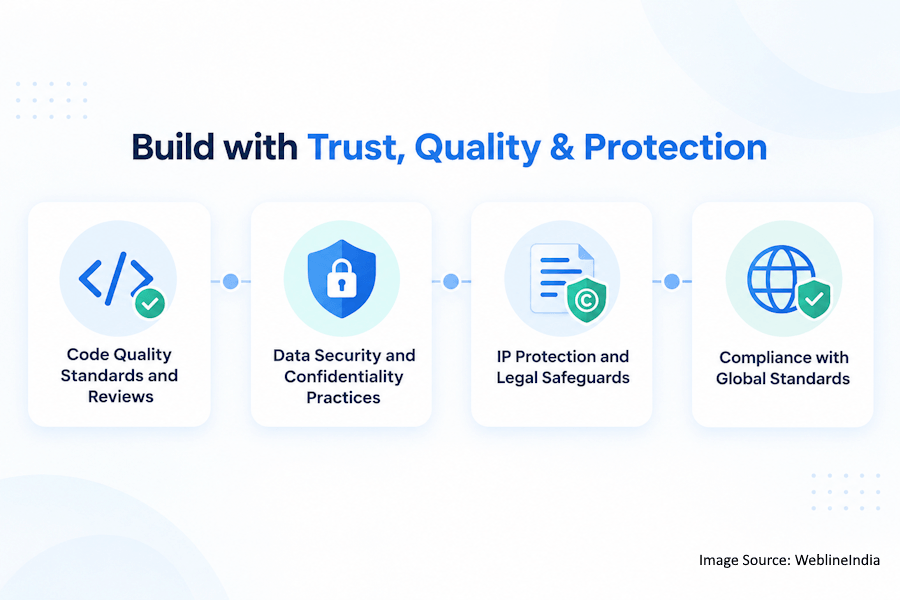
- Code Quality Standards and Reviews: Leading teams implement a peer-review system where every line of code is checked by another senior developer. This ensures adherence to “Clean Code” principles and prevents bugs from reaching the production environment.
- Data Security and Confidentiality Practices: Strong internal policies ensure that only authorized personnel have access to sensitive environments. Using VPNs, encrypted workstations, and strict access controls, Indian teams maintain a high-security posture.
- IP Protection and Legal Safeguards: Intellectual Property (IP) is protected through robust Non-Disclosure Agreements (NDAs) and Master Service Agreements (MSAs). These legal frameworks ensure that all code, designs, and logic belong 100% to the founder.
- Compliance with Global Standards: Modern SaaS development in India follows international regulations. Whether it’s GDPR for European privacy, HIPAA for healthcare, or SOC2 for enterprise security, the teams ensure your product meets the necessary legal benchmarks.
Cost vs. Value: The Real ROI of Hiring an Indian Dedicated Team
Founders often look at the hourly rate first, but the true Return on Investment (ROI) comes from the long-term value created by a stable, high-performing team.
- Cost Savings Compared to In-house Teams: Hiring an in-house team involves salaries, benefits, office space, hardware, and recruitment fees, while software development outsourcing can shift many of these operational responsibilities to an external partner. By choosing to hire dedicated development team India professionals, you eliminate these overheads, often reducing your “burn rate” by 60-70%.
- Faster Go-to-Market and Reduced Opportunity Cost: In the SaaS world, being first can be the difference between winning and losing. Because Indian partners have ready-to-deploy talent, you can start development in days rather than months, capturing market share faster.
- Ability to Reinvest Savings into Growth: The capital saved on development isn’t just extra money. It can be redirected into aggressive marketing, sales, and customer acquisition, which are critical for scaling a SaaS business.
- Long-term Value Creation: A dedicated team builds a knowledge base. They understand the why behind your features, leading to fewer errors and faster feature releases over time, which is much more valuable than the short-term savings of a cheap freelancer.
The ROI Battle: Remote Dedicated Team vs. In-house
| Metric | In-House Team (US/UK/EU) | Dedicated Team (India) |
| Recruitment Time | 3–6 Months | 2–4 Weeks |
| Annual Cost (Approx) | $150k – $250k per dev | $40k – $70k per dev |
| Operational Overhead | High (HR, Office, Benefits) | Zero (Managed by Partner) |
| Flexibility | Low (Difficult to downsize) | High (Easy to scale up/down) |
| ROI Potential | Moderate | Maximum (High Output/Low Cost) |
Common Pitfalls to Avoid When Hiring Offshore SaaS Teams
Success in SaaS development in India requires avoiding a “commodity” mindset. Many founders fail because they treat offshore teams as simple task executors rather than strategic partners. Lack of clear documentation, ignoring the need for a scalable architecture early on, and prioritizing the absolute lowest price over technical competence often lead to expensive rewrites and missed deadlines.
Real-World Use Cases: SaaS Products Built with Indian Teams
- Early-Stage Startup MVP Success: A FinTech founder used a team in India to build a core ledger system in just 12 weeks. This allowed them to secure Seed funding by demonstrating a functional, secure product to investors ahead of schedule.
- Scale-up SaaS Platforms: An EdTech platform serving 500,000 users migrated its monolithic backend to microservices. They chose to hire dedicated development team India, and achieved 99.99% uptime and handled a 5x spike in traffic during peak enrollment.
- Enterprise SaaS Modernization: A legacy HR-tech company modernized its UI/UX and moved to a multi-tenant cloud architecture. The Indian team ensured zero data loss during migration while adding advanced AI-driven analytics features.
- Key Takeaways: These journeys prove that with the right partner, offshore teams provide the technical backbone necessary for both rapid market entry and sustained global scaling.
How to Choose the Right Indian MVP Development Partner
Finding the right partner is about looking beyond the sales pitch to find a team that truly understands the SaaS model.
- Evaluate Technical Expertise: Look for a history of building multi-tenant applications and managing cloud infrastructure.
- Assess Communication Maturity: Ensure they use modern project management tools and have a clear process for handling feedback.
- Importance of Long-term Mindset: Choose a partner interested in your product’s growth, not just closing a single contract.
- Founder Questions to Ask:
- What is your process for managing technical debt?
- How do you handle security and data privacy compliance?
- Can you scale the team size within 30 days if our roadmap changes?
- Do you have experience with our specific tech stack at scale?
From MVP to Scale: Why the Right Team from WeblineIndia Is a Growth Multiplier
The journey of a SaaS product is an evolution that requires different skills at every turn. From the high-speed validation of an MVP to the complex infrastructure of a global scale-up, the technical foundation you lay today determines your ceiling tomorrow. Opting for SaaS development in India provides the perfect blend of technical depth, cultural alignment, and cost-efficiency.
When you decide to hire dedicated development team India, you aren’t just outsourcing work; you are onboarding a catalyst for growth. These teams allow you to focus on your core strengths—vision, sales, and strategy—while they ensure your technology is robust, secure, and ready for the world.
Looking to hire a dedicated development team in India for your SaaS product?
Frequently Asked Questions
Why is it better to hire a dedicated development team in India for a SaaS startup?
Founders choose to hire dedicated development team India because they offer a unique combination of high-level technical skill and cost-efficiency. Unlike freelancers, a dedicated team provides long-term ownership of your product. For SaaS development in India, this means you get access to engineers who understand multi-tenant architecture and subscription logic, ensuring your MVP is built on a foundation that can scale globally without needing a total rewrite.
How does SaaS development in India help in scaling from MVP to Enterprise?
The ecosystem for SaaS development in India is highly mature, with deep expertise in cloud-native technologies and DevOps. When you hire dedicated development team India, they assist in the transition by refactoring code, implementing microservices, and ensuring high security. This specialized focus helps SaaS products handle thousands of concurrent users and complex third-party integrations as they grow from a simple prototype to a market-ready solution.
What are the cost benefits when I hire a dedicated development team in India?
The primary ROI when you hire dedicated development team India professionals is the significant reduction in burn rate. Founders can save up to 60-70% on operational costs compared to hiring an in-house team in the US or Europe. These savings allow startups to reinvest more capital into marketing and customer acquisition. Furthermore, the established processes in SaaS development in India reduce the "time-to-market," helping you generate revenue much faster.
How do you manage the time-zone difference with an Indian dedicated team?
Managing the gap is easy when you hire dedicated development team India specialists who follow an overlap schedule. Most teams in the SaaS development in India sector work on a "follow-the-sun" model. They provide a 3-to-4-hour overlap with your business day for Agile ceremonies and standups. This ensures that while you sleep, your dedicated team is building features, and by the time you start your day, the latest updates are ready for review.
Is my Intellectual Property (IP) safe during SaaS development in India?
Yes, security and IP protection are top priorities for professional firms. When you hire dedicated development team India, the collaboration is governed by strict legal contracts, including NDAs and MSAs. Reputable companies for SaaS development in India follow global compliance standards like GDPR and SOC2, ensuring that your source code, user data, and business logic remain your exclusive property throughout the entire lifecycle.
Globally Recognized for Unmatched Quality and Reliability


Testimonials: Hear It Straight From Our Global Clients
Our development processes delivers dynamic solutions to tackle business challenges, optimize costs, and drive digital transformation. Expert-backed solutions enhance client retention and online presence, with proven success stories highlighting real-world problem-solving through innovative applications. Our esteemed Worldwide clients just experienced it.
Awards and Recognitions
While delighted clients are our greatest motivation, industry recognition holds significant value. WeblineIndia has consistently led in technology, with awards and accolades reaffirming our excellence.

OA500 Global Outsourcing Firms 2025, by Outsource Accelerator

Top Software Development Company, by GoodFirms

BEST FINTECH PRODUCT SOLUTION COMPANY - 2022, by GESIA

Awarded as - TOP APP DEVELOPMENT COMPANY IN INDIA of the YEAR 2020, by SoftwareSuggest